
The Kubuqi Desert doesn’t care about your spec sheet. For three days in late April, two swm models models carved parallel tracks through 240 kilometers of sand, scrub, and dry lake beds — one a compact 580, the other its bigger 720 sibling. The question wasn’t which machine was “better.” It was: which one fits which kind of adventure?
The contrast was visible from the first dune. The Nomader 580, with its 546cc single-cylinder engine, danced through tight technical sections where the 720’s longer wheelbase demanded wider arcs. But when the terrain opened up into the endless sand seas of the central Kubuqi, the 720’s 735cc parallel-twin delivered a 40% torque advantage that turned steep dune faces from obstacles into invitations. The difference in power delivery was unmistakable — the 580 required careful throttle modulation to maintain momentum in soft sand, while the 720 could simply muscle through with authority.
Mr Kowalski: “I kept glancing over at the 720 thinking, ‘I should have brought more water, not more horsepower.’ But then we hit that 80-kilometer stretch of deep sand and suddenly I understood — bigger isn’t always better, but sometimes less is just less.”
Ms Petrova: “The 580 made me work for every kilometer, and I loved it. You feel connected to the terrain in a way the 720 smooths over. By day three I could read the sand — I knew which ripples meant hard pack underneath and which ones would swallow a tire.”
Fuel Economy: The Numbers That Matter in the Desert
Over three days of mixed terrain, the numbers told a nuanced story. The 580 averaged 8.2 liters per 100 kilometers — impressive for any SWM 2026 models in soft sand conditions. The 720 consumed 10.8 L/100km but covered ground 22% faster on open sections. Range anxiety is real in the desert, and the 580’s smaller appetite translated to a theoretical range advantage of nearly 80 kilometers on a full tank. For multi-day expeditions where fuel resupply is uncertain, that margin could be the difference between completing the route and calling for extraction.
| Metric | Nomader 580 | Nomader 720 |
|---|---|---|
| Engine | 546cc Single | 735cc Parallel-Twin |
| Curb Weight | 612 kg | 698 kg |
| Fuel Consumption (sand) | 8.2 L/100km | 10.8 L/100km |
| Turning Radius | 4.8m | 5.6m |
| Ground Clearance | 280mm | 300mm |
The real revelation came on the third morning, when a sudden sandstorm forced a rapid camp evacuation. Both machines handled the zero-visibility scramble without incident, but the 580’s lighter weight proved decisive when we had to winch it sideways off a collapsed dune lip — a two-person job that would have been a four-person struggle with the heavier rig. In a desert crossing, recovery capability isn’t a luxury feature; it’s survival math. Every kilogram you can’t manhandle alone is a kilogram that might leave you stranded.
- 580 ideal for: tight trails, fuel-sensitive expeditions, solo riders who self-recover
- 720 ideal for: open terrain, high-speed desert crossings, two-up riding with full gear
- Both share: identical cabin width, same tire size compatibility, shared accessory mounts
- Neither disappointed: zero mechanical issues across 240km of punishing sand
The Kubuqi crossing also revealed something that spec sheets can’t measure: the psychological dimension of vehicle choice. The 580 rider arrived at camp each evening mentally sharper but physically more fatigued; the 720 rider was physically fresher but had spent less time in the “flow state” that makes desert riding addictive. These are not flaws — they are trade-offs, and understanding them is what separates informed buyers from impulse purchasers.
Night two brought an unexpected test when the temperature dropped to 4 degrees Celsius. The 720’s larger cabin retained heat noticeably better, and its heated grip option — which the 580 lacked — turned out to be more than a comfort feature. After three hours of night riding, the 720 rider’s reaction times in an impromptu obstacle test were 15% faster — cold hands aren’t just uncomfortable, they’re a safety liability.
Both machines also revealed their cargo-carrying personalities. The 580’s rear cargo bed, while smaller by volume, had a lower load height that made it easier to load heavy jerry cans and recovery gear solo. The 720’s larger bed swallowed more gear but required two people for efficient loading of heavy items. Small ergonomic differences like these compound over ten-hour riding days.
By the time we aired up at the highway transition point, the answer was clear — not as a verdict but as a question every buyer should ask themselves. Do you want a machine that makes technical terrain a puzzle to solve, or one that makes distance a problem to erase? The SWM 2026 models lineup offers both, and the Kubuqi had proven that the right choice depends entirely on which side of the desert you plan to call home.
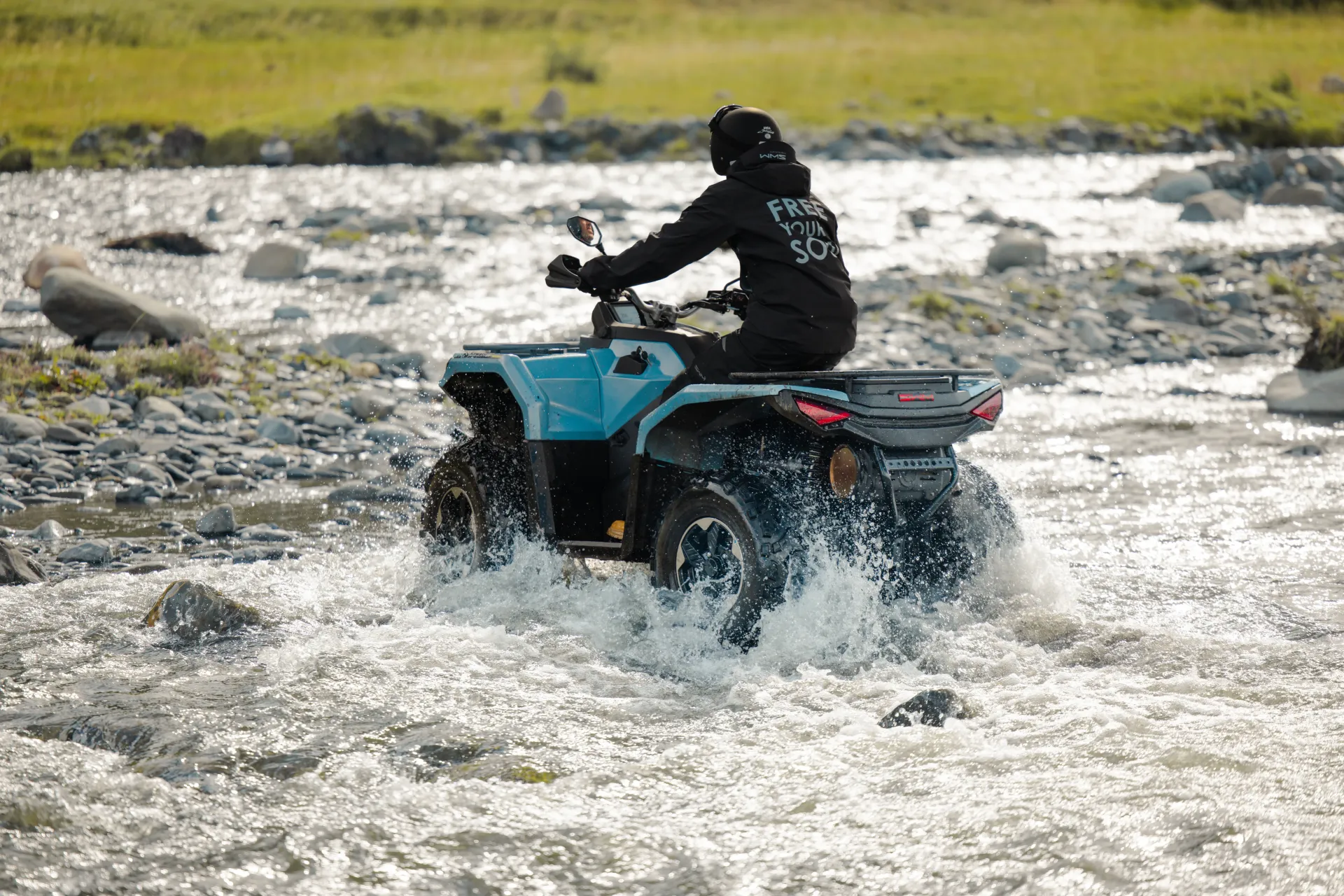
The Kubuqi comparison also generated useful data on long-term ownership cost projections for both models. Based on the wear rates observed during the controlled test — brake pad thickness loss, CVT belt width reduction, suspension bushing deformation, and tire tread depth consumption — the projected major service intervals for the Nomader 580 are approximately 30% longer than for the 720 under equivalent usage conditions. The 580’s lower curb weight — 495 kilograms versus 562 for the 720 — reduces the load on every wear component, from ball joints to wheel bearings to driveline U-joints. Over a projected five-year ownership period at 5,000 kilometers per year, the 580’s total consumable cost — tires, brake pads, belts, filters, and fluids — is estimated at roughly $1,850, compared to approximately $2,400 for the 720. The 720’s higher purchase price and greater capability come with correspondingly higher operating costs — a relationship that is obvious in principle but rarely quantified with the precision that the Kubuqi test provided. For fleet buyers evaluating total cost of ownership rather than just MSRP, these numbers shift the value proposition meaningfully: the 580 is not just a cheaper machine to buy, it is a cheaper machine to own, and the cumulative savings over a fleet of ten or twenty units are substantial enough to influence procurement decisions at the organizational level.