
A powerful gaming computer can make a significant difference when playing modern games at high resolutions. With detailed environments, realistic lighting, advanced textures, and demanding graphics effects, 4K gaming requires strong hardware that can deliver smooth performance without sacrificing visual quality. For gamers who want a premium experience without building a computer themselves, a prebuilt system equipped with an NVIDIA GeForce RTX 5080 is worth considering. 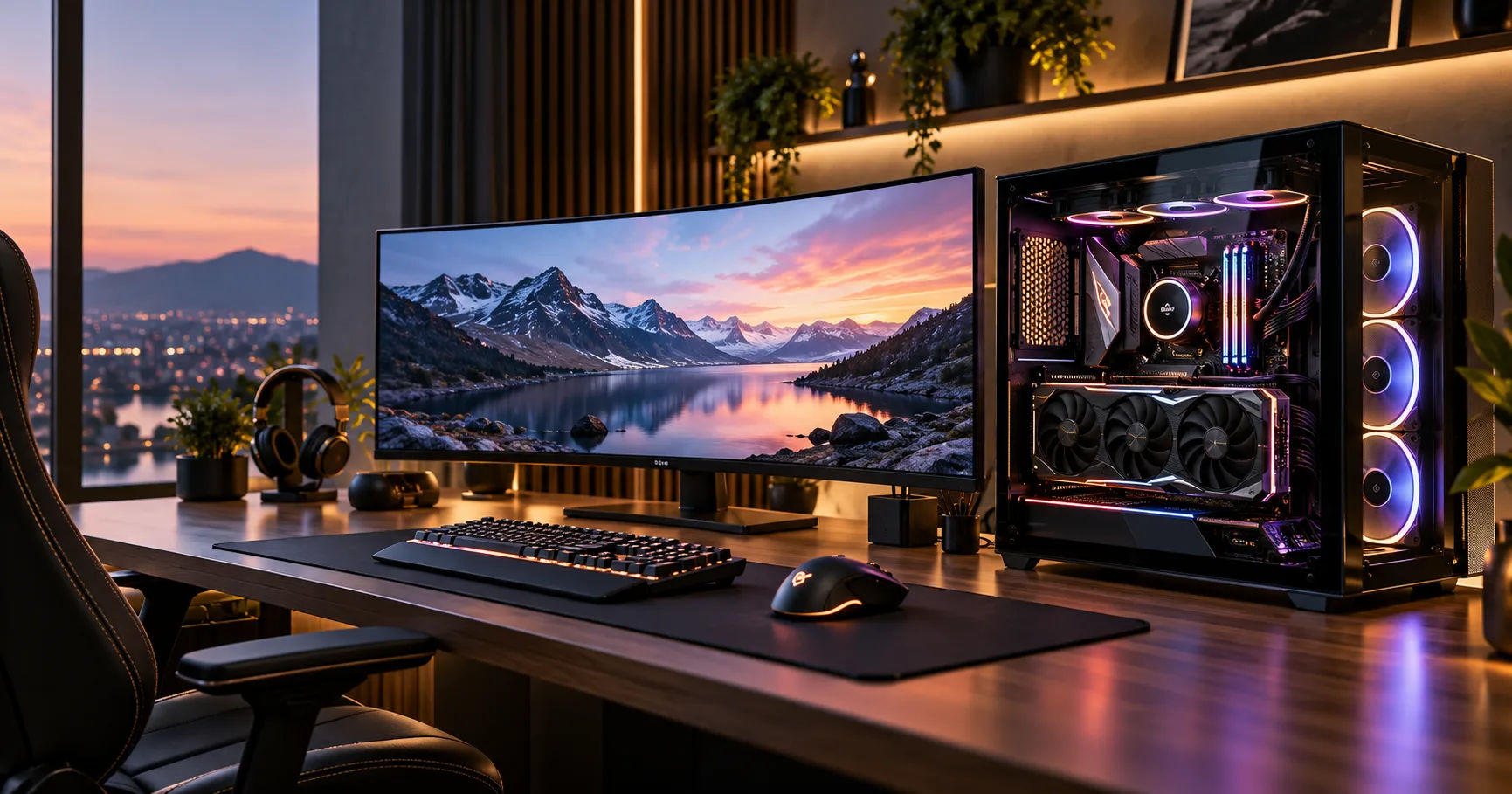 Choosing the best 5080 prebuilt pc can be an excellent way to enjoy 4K gaming, especially if you want impressive graphics, high frame rates, and support for modern technologies such as ray tracing and AI-powered upscaling. However, the graphics card is only one part of the equation. The processor, memory, cooling system, power supply, and overall system design also influence performance.
Before spending money on a high-end gaming computer, it is important to understand what the RTX 5080 can deliver, which specifications matter most, and whether a prebuilt system offers good value for your gaming needs.
This comprehensive guide explains how these computers perform at 4K resolution, which components to prioritize, what limitations to expect, and how to choose a system that remains useful for years.
4K Gaming and the RTX 5080
4K gaming means playing games at a resolution of 3840 × 2160 pixels. This resolution provides four times as many pixels as standard 1080p Full HD, creating sharper images, clearer textures, and more detailed environments.
However, rendering all those pixels places a substantial workload on the graphics card. Games with complex lighting, detailed environments, and realistic reflections can demand considerable processing power, particularly when ray tracing is enabled.
The NVIDIA GeForce RTX 5080 is a high-end graphics card based on the Blackwell architecture. It includes 16 GB of GDDR7 video memory and supports modern rendering features designed to improve visual quality and gaming performance.
These capabilities make it well suited to demanding gaming setups, including systems built for 4K monitors and large-screen displays.
Why the RTX 5080 Is Suitable for 4K
The RTX 5080 has the processing power needed to run many modern games at 4K with high or ultra graphics settings. Its performance makes it a strong option for players who prefer image quality over lower-resolution gaming.
In less demanding games, it can deliver very high frame rates. In graphically intensive titles, performance depends on the game, graphics settings, ray tracing options, and whether upscaling is enabled.
A good prebuilt system combines this graphics card with balanced components so that the processor, memory, and cooling solution do not unnecessarily restrict its capabilities.
The Importance of DLSS and Frame Generation
Modern NVIDIA graphics cards support DLSS, a collection of technologies that can improve performance by rendering a game at a lower internal resolution and reconstructing a sharper image.
Frame Generation can also create additional frames between conventionally rendered frames in supported games. This can make motion appear smoother, especially when the underlying performance is already reasonably strong.
These features are particularly helpful at 4K, where native rendering can be demanding. However, generated frames are not equivalent to traditionally rendered frames in responsiveness. For competitive games, actual rendering performance and input latency remain important.
Upscaling and Frame Generation should therefore be treated as useful tools rather than substitutes for capable hardware.
How Well Does the Best 5080 Prebuilt PC Perform at 4K?
The actual performance of an RTX 5080 gaming computer depends on the game and the settings you choose. Some titles run comfortably above 100 frames per second, while demanding games with maximum ray tracing may require DLSS or reduced graphics settings to maintain smooth gameplay.
Independent testing illustrates this variation. For example, GamesRadar+ reported approximately 71 FPS in Cyberpunk 2077 at 4K with ray tracing disabled, compared with around 35 FPS with ray tracing enabled in its test configuration. Hitman 3 achieved much higher performance in the same review. These figures are examples from specific tests, not guaranteed results for every prebuilt computer.
Performance in Different Types of Games
Here is what you can generally expect from a well-configured RTX 5080 desktop.
|
Game category |
Expected 4K experience |
|---|---|
|
Competitive esports |
Very high frame rates in many games |
|
Racing and sports games |
Smooth gameplay with high settings |
|
Open-world adventures |
Strong performance, depending on optimization |
|
Modern AAA games |
Good 4K performance with settings adjusted when necessary |
|
Ray-tracing-heavy games |
May benefit substantially from DLSS |
|
Path-tracing games |
Often require upscaling and frame generation for higher displayed frame rates |
These are broad expectations rather than fixed benchmark results. Game updates, processor choice, memory configuration, and individual graphics settings can change performance considerably.
Can It Deliver 60 FPS at 4K?
Yes. A well-built RTX 5080 system can deliver 60 FPS or more in many games at 4K, including demanding titles. However, consistently achieving that target with every setting at maximum is not guaranteed.
Ray tracing, path tracing, and unusually demanding game engines can push performance below 60 FPS. In those situations, lowering a few demanding settings or enabling DLSS can help.
For most single-player games, a stable 60 FPS is an excellent starting point. Gamers using 120 Hz or 144 Hz monitors may want higher frame rates, which are more achievable in lighter games and with carefully selected settings.
Which Components Should a 4K Gaming Prebuilt PC Include?
A high-end graphics card deserves equally careful supporting components. When evaluating the best 5080 prebuilt pc, look beyond the product title and examine the complete specification sheet.
1. A Powerful Gaming Processor
The CPU handles game logic, artificial intelligence, physics, background tasks, and communication with the graphics card. At 4K, the GPU is often the main performance limitation, but the processor still matters.
A modern AMD Ryzen 7 X3D processor, such as the Ryzen 7 9800X3D, is an attractive choice for a premium gaming system. Its large cache and gaming-focused design can provide strong performance in CPU-intensive titles.
Other modern Ryzen 7, Ryzen 9, and Intel Core Ultra processors can also work well, depending on their gaming performance, power requirements, and price.
Avoid paying extra for a top-tier processor if the improvement is small for your intended games. A balanced CPU and GPU combination is usually better value than spending heavily on one component while neglecting the rest.
2. At Least 32 GB of System RAM
For a premium 4K gaming desktop, 32 GB of DDR5 memory is a sensible target. It provides enough capacity for most modern games, launchers, voice chat, web browsers, and other background applications.
Some games and creative workloads benefit from 64 GB, but this capacity is not essential for most gaming-only systems.
Check whether the computer uses two memory modules rather than relying on a single module. A properly configured dual-channel memory setup can improve performance in CPU-sensitive situations.
Also check the motherboard's supported memory speeds and compatibility. Capacity matters, but so does a sensible configuration.
3. Fast NVMe SSD Storage
A 1 TB NVMe SSD is a reasonable minimum for a gaming computer, but 2 TB is preferable if you maintain a large library of modern games.
Many current titles require substantial storage space, and several large installations can quickly fill a 1 TB drive.
NVMe storage helps games load quickly and makes installing or updating large files more convenient. However, a faster SSD does not automatically increase average gaming FPS significantly.
A prebuilt PC with a 2 TB SSD may offer better everyday convenience than a similar-priced model with a smaller drive, particularly if you do not want to upgrade storage immediately.
4. A Reliable Power Supply
The RTX 5080 is a powerful component that needs an appropriate power supply. NVIDIA lists a 360-watt total graphics card power rating and a 850-watt required system power recommendation for its reference specifications, although requirements can vary with the complete system and graphics card model.
For a typical high-end configuration, a quality 850 W power supply is a reasonable starting point. A 1,000 W unit may be appropriate for certain power-hungry processors, factory-overclocked graphics cards, or systems with substantial expansion plans.
Look for a reputable PSU with suitable protections, the correct connectors, and support for the system's power requirements. A high wattage printed on a low-quality unit is not a substitute for reliable engineering.
5. Effective Cooling and Airflow
A powerful gaming PC generates substantial heat during long gaming sessions. The case should have a clear path for cool air to enter and warm air to escape.
Look for multiple case fans, a well-ventilated front panel, and a CPU cooler appropriate for the installed processor. A good tower air cooler can be sufficient for many CPUs, while some high-end configurations benefit from a larger liquid cooler.
The graphics card also needs adequate space and airflow. A cramped case can restrict cooling and make fans louder.
Cooling quality affects more than temperatures. Good thermal management helps components maintain their intended performance and can improve comfort during extended gaming sessions.
Is Liquid Cooling Necessary for an RTX 5080 Prebuilt PC?
Liquid cooling is not automatically necessary just because a computer contains an RTX 5080. The graphics card has its own cooling system, and the processor requires a separate cooler.
For many gaming builds, a good air cooler and a well-ventilated case provide sufficient cooling. A 240 mm or 360 mm all-in-one liquid cooler may be useful for a high-power processor, especially if the system is designed for low noise or sustained heavy workloads.
Before choosing a liquid-cooled model, consider these factors:
-
CPU requirements: Some processors generate more heat than others.
-
Case design: Good airflow is important regardless of cooler type.
-
Noise levels: Larger coolers can sometimes operate more quietly under load.
-
Maintenance and reliability: Liquid coolers contain a pump and additional components that can eventually fail.
-
Price: Spending more on cooling is not worthwhile if the existing solution already handles temperatures effectively.
A premium prebuilt computer should include cooling that matches its actual components, not just a flashy liquid-cooling system designed to look impressive.
What Monitor Should You Use for 4K Gaming?
Even a powerful computer cannot show its full potential without a suitable display. Your monitor determines how much detail you see and how many frames you can display each second.
4K 60 Hz Monitors
A 4K 60 Hz monitor is suitable for gamers who prioritize image quality, cinematic experiences, and single-player adventures.
If you mainly play story-driven games, strategy titles, or slower-paced simulations, 60 Hz can provide a satisfying experience. You do not necessarily need an expensive high-refresh-rate display to enjoy 4K gaming.
4K 120 Hz and 144 Hz Monitors
For a more responsive gaming experience, consider a 4K monitor with a 120 Hz or 144 Hz refresh rate.
These displays can show more frames per second, making motion look smoother when the computer can produce sufficiently high frame rates. They are especially appealing for racing games, action games, and competitive titles.
An RTX 5080 is a strong match for this class of display, although demanding games may not maintain 120 FPS at native 4K with every graphical feature enabled.
Adaptive-sync support can also help reduce visible tearing when the frame rate fluctuates.
OLED Versus IPS
OLED monitors generally provide excellent contrast, deep blacks, and fast pixel response times. They are attractive for immersive gaming, especially in dark environments.
IPS monitors can offer strong colors, wide viewing angles, and good brightness, often at different price points. The right choice depends on your budget, room lighting, preferred games, and tolerance for OLED burn-in considerations.
Remember that a monitor upgrade can improve your overall experience as much as a small increase in graphics performance.
How Much Should You Spend on a 5080 Prebuilt PC?
The price of a prebuilt computer varies according to its components, brand, case design, warranty, and local market conditions.
The RTX 5080 itself launched with a US reference price of $999, but that figure is not the price of a complete gaming PC. Retail pricing and availability can change, and buyers in Pakistan may face additional costs associated with importing, shipping, taxes, and local warranties.
When comparing prices, evaluate the entire package instead of focusing only on the graphics card.
What Justifies a Higher Price?
A more expensive computer may offer genuine advantages, including:
-
A faster gaming processor.
-
A larger SSD.
-
A premium motherboard with useful connectivity.
-
A reliable power supply with sufficient capacity.
-
Better case ventilation and quieter cooling.
-
More accessible upgrade options.
-
A strong warranty and dependable technical support.
However, RGB lighting, decorative panels, and premium branding do not necessarily improve gaming performance.
The best 5080 prebuilt pc is not automatically the most expensive model. It is the one that delivers the right balance of performance, reliability, cooling, and price for your needs.
Is It Better to Build Your Own PC?
Building your own system can sometimes reduce costs and give you more control over component selection. You can choose the exact graphics card, motherboard, cooler, case, and power supply.
However, building requires time, technical knowledge, and responsibility for troubleshooting compatibility or installation problems.
A prebuilt system is attractive if you prefer convenience, professional assembly, a single point of contact for warranty support, and a computer that arrives ready to use.
The best option depends on your confidence with hardware and the price difference between comparable configurations.
What Are the Limitations of the RTX 5080?
Although the RTX 5080 is a powerful graphics card, it is important to understand what it cannot guarantee.
16 GB of VRAM May Require Careful Settings
The RTX 5080 includes 16 GB of GDDR7 video memory. This is substantial capacity for gaming, but exceptionally demanding textures, advanced rendering features, and some future games may put pressure on available memory at 4K.
If a game exceeds available VRAM, performance or smoothness can suffer, depending on the engine and settings.
This does not mean 16 GB is inadequate for 4K gaming today. Rather, it means buyers should avoid assuming that every future game will run at maximum settings indefinitely.
Maximum Ray Tracing Can Be Demanding
Ray tracing can create more realistic lighting, shadows, and reflections, but its computational cost can be considerable.
Path tracing is even more demanding in supported games. Although the RTX 5080 supports technologies that improve performance, native rendering with every advanced effect enabled may still be challenging.
For the best balance, start with high-quality settings, test performance, and adjust the most demanding options individually.
It Is Not the Fastest Possible Gaming GPU
The RTX 5080 sits below the more powerful RTX 5090 in NVIDIA's desktop graphics lineup. Independent benchmarks also show that the RTX 5090 can deliver considerably higher 4K performance in demanding workloads.
However, the faster card is not automatically the better purchase for everyone. Its additional cost must be justified by the improvement you will actually notice.
For many gamers, the RTX 5080 offers a more balanced route to high-quality 4K gaming without paying for the highest available graphics tier.
How to Choose the Best 5080 Prebuilt PC
Before buying, compare several complete systems and verify their specifications. Product listings sometimes emphasize the GPU while providing limited information about the components that affect reliability and long-term value.
Use this checklist to evaluate your options.
Also confirm the exact model of each component. Two computers with similar headline specifications can differ substantially in power-supply quality, motherboard features, cooling performance, and upgrade flexibility.
If possible, look for reviews that measure gaming performance, temperatures, fan noise, and power consumption under sustained workloads.
Is the Best 5080 Prebuilt PC Worth It for Different Gamers?
Not every gamer has the same requirements. Understanding your priorities makes it easier to determine whether this class of computer is worth the investment.
For Single-Player Gaming
If you enjoy visually demanding games, expansive open worlds, and cinematic adventures, an RTX 5080 system is an excellent option to consider.
It can provide detailed 4K visuals and strong performance, with DLSS available when additional rendering efficiency is needed.
For Competitive Gaming
Competitive players may benefit from the high frame rates the system can produce in less demanding games. However, esports titles do not always need an RTX 5080 to run well.
If your primary goal is competitive play at 1080p or 1440p, a less expensive computer might offer better value. The RTX 5080 makes more sense if you also want premium 4K gaming or plan to use a high-refresh-rate 4K monitor.
For Streaming and Content Creation
A powerful gaming desktop can also serve as a workstation. The RTX 5080 supports modern video encoding, GPU-accelerated creative applications, and AI-related workloads.
A suitable processor, sufficient RAM, and adequate storage become especially important if you plan to record gameplay, stream, edit videos, or run several demanding applications simultaneously.
For these users, the system can provide value beyond gaming alone.
Conclusion
Yes, the best 5080 prebuilt pc can be an excellent choice for 4K gaming. Its powerful graphics hardware, 16 GB of GDDR7 memory, ray-tracing capabilities, and support for DLSS make it suitable for many demanding modern games. It can deliver high-quality visuals, smooth gameplay, and strong performance across a wide range of gaming experiences.
However, the graphics card alone does not determine whether a computer is worth buying. A capable processor, 32 GB of RAM, fast SSD storage, a reliable power supply, and effective cooling are all important parts of a well-balanced system. Choosing a suitable 4K monitor also helps you take full advantage of the hardware.
You should keep realistic expectations about demanding games. Maximum ray tracing and path tracing can reduce frame rates substantially, and 16 GB of VRAM does not guarantee that every future title will run at maximum settings. DLSS and Frame Generation can help, but actual rendering performance and responsiveness still matter.
Before purchasing, compare complete configurations, check independent reviews, and examine warranty coverage. Do not pay extra for decorative features while overlooking component quality or cooling.
Ultimately, an RTX 5080 prebuilt is best suited to gamers who want premium 4K performance without assembling a computer themselves. If the price fits your budget and the remaining components are carefully selected, it can provide an impressive gaming experience and a strong foundation for years of enjoyable play.